
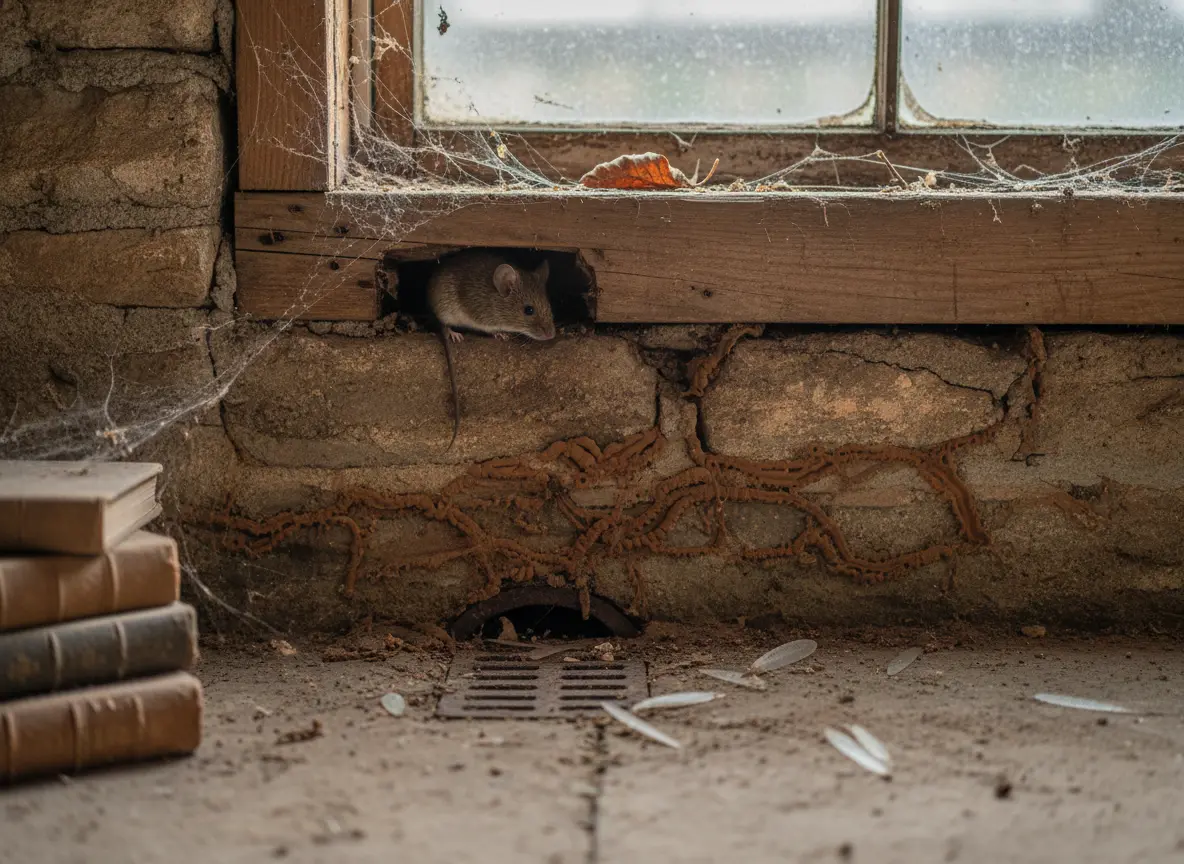
Mice in a Youngstown basement in October are usually outdoor mice looking for a warm, dry place to spend the winter. They get in through openings about 1/4 inch wide, most often where the house framing sits on the foundation (the sill plate), through gaps in old mortar, and around pipes, wires and the dryer vent. Seal those gaps with metal-based materials, trap what is already inside, and the problem usually stops. For help, call (888) 752-0103.
Why October brings mice in, year after year
Most house mice spend the warm months outside, in tall grass, wood piles, sheds and garden beds. When fall nights turn cold, many of them look for a protected place to spend the winter. University of New Hampshire Extension puts it simply: cooler fall weather sends mice looking for shelter, and a warm house is the perfect spot.
A basement is the easiest part of the house to reach. It sits right at ground level, where mice already travel. It is dark, quiet and often cluttered with boxes. It also has water. Mice need only about 0.4 ounces of water a day, and they will lap condensation off cold pipes, according to the Internet Center for Wildlife Damage Management (ICWDM).
The timing feels the same every year because the trigger is the same every year. Food outside gets scarce, cover dies back, and the heat inside your foundation walls becomes the warmest spot on the block.

How mice actually get into a basement
The Centers for Disease Control and Prevention (CDC) says a mouse can fit through a hole the width of a pencil, about 1/4 inch. Penn State Extension compares it to the size of a dime. If its head fits, the body follows. That is why a small gap matters more than most people expect.
Here are the entry points we check first on a basement mouse inspection in the Youngstown area.
1. The sill plate
The sill plate is the wood board that sits on top of the foundation wall and holds up the house framing. Older stone and block walls are rarely flat, so small gaps often run along this joint. ICWDM's rodent-proof construction guide says gaps where wall framing or siding meets the foundation give rodents easy access. From inside the basement, look along the top of the wall between the floor joists. Daylight, cobwebs that move in a draft, or dark rub marks are clues.
2. Old mortar in stone or block walls
If your house has a fieldstone or block foundation, the mortar between stones can crumble over decades. Mice can squeeze through a loose joint or a gap behind a stone. ICWDM recommends repairing foundation cracks with concrete or masonry grout, not foam.
3. Utility penetrations
Every pipe or wire that passes through the wall is a possible opening. That includes gas lines, water lines, AC refrigerant lines, cable and phone lines, and the main electric feed. The hole drilled for a pipe is often bigger than the pipe itself. The CDC lists electrical, water, gas and sewer lines among the places to check inside and out.
4. The dryer vent
A dryer vent hood with a broken or stuck flap is a warm, lint-lined doorway. Also check the gap between the vent pipe and the wall. ICWDM's guide calls out dryer vents and says to seal gaps between the pipe and the structure. Never put mesh over a dryer vent outlet, since lint can clog it. Use a vent cover made for dryers instead.
5. Basement windows, doors and drains
Old basement window frames shrink and rot. Bulkhead doors and walkout doors without a good sweep leave a gap at the bottom. Penn State Extension notes that many mice come in the same way people do, through the doorway. Floor drains without a grate can also be an entry route.
How to tell it is mice and not something else
Mouse droppings are dark, pointed at the ends and about 1/8 to 1/4 inch long, according to UNH Extension. You may also notice:
- Droppings along walls, on shelves or near the furnace and water heater
- Shredded paper, insulation or fabric balled into a nest about 4 to 6 inches across (ICWDM)
- Dark, greasy rub marks around holes and along the sill plate
- Scratching in the ceiling or walls at night
- Chewed food packages, pet food or birdseed bags
Rat droppings are clearly larger and thicker, and rats need a bigger hole. If the droppings look large, or you see burrows along the foundation outside, call us so we can check for Norway rats. Inside Youngstown city limits, the Youngstown City Health District's Environmental Health Division also runs a rat control program for the community.
Why a few mice turn into a lot of mice
One mouse can become a colony within one winter. ICWDM reports that a female can have 5 to 10 litters a year, with 5 or 6 young per litter, and the young can breed within 6 to 10 weeks. Each mouse stays in a small area, usually 10 to 30 feet across, so a basement can hold a whole family without you seeing them in the kitchen.
This is why a single sighting in October is worth taking seriously. It is much easier to deal with 2 mice in the fall than 20 by February.

What to do about mice in your basement
The method that works is the same one pest professionals use, called Integrated Pest Management (IPM). In plain terms: find the gaps, close them, remove what the mice are living on, and trap the ones already inside.
Seal the gaps with the right materials
Expanding foam alone does not stop mice. ICWDM states it helps with heat loss but will not prevent rodent entry. The CDC suggests these materials instead:
- Small holes: pack with steel wool or copper wool, then caulk over it to hold it in place.
- Larger holes: use hardware cloth, lath screen, sheet metal or cement.
- Vents: 1/4 inch hardware cloth on foundation and attic vents, but a proper dryer vent cover on the dryer outlet.
- Doors: a door sweep on any exterior or bulkhead door.
Trap, do not poison, inside the house
The CDC recommends snap traps and advises against glue traps and live traps, which can scare rodents into urinating and raise the risk of illness. Set traps against walls where you see droppings, with the bait end facing the wall. A small amount of peanut butter works. Keep traps where kids and pets cannot reach them.
We do not recommend loose poison bait inside a home. A mouse that eats it can die inside a wall, and bait can reach pets or children. If bait stations are needed outside, a licensed applicator places tamper-resistant stations and follows the product label.
Take away food and cover
- Store pet food, birdseed and grass seed in metal or hard plastic bins.
- Move cardboard boxes off the floor and onto shelves, and use plastic tubs.
- Fix leaky pipes and run a dehumidifier if the basement stays damp.
- Keep firewood, mulch and tall plants a few feet away from the foundation.
Clean up droppings safely
Do not sweep or vacuum droppings or nests, because that can put particles into the air. The CDC says to open doors and windows for 30 minutes, wear rubber or plastic gloves, and spray the area with a bleach solution (1 part bleach to 9 parts water) or an EPA-registered disinfectant. Let it soak for 5 minutes, then wipe up with paper towels and throw them out in a covered trash can.
Not sure where your mice are getting in? Our rodent control visit starts with a full basement and exterior check. If the main problem is gaps, our home sealing and pest exclusion service closes them with gnaw-resistant materials. Call (888) 752-0103.
When to call a pest professional
Call for help if you keep catching mice after 2 weeks, if you cannot find where they get in, if droppings are in the kitchen or near food, or if you hear activity inside finished walls. A technician can reach tight spots like the sill plate behind ductwork and the top of a stone wall behind insulation.
We serve homes across Youngstown neighborhoods like the North Side and nearby communities like Austintown. Many houses in this area have basements with older foundations, which is exactly where fall mouse problems start.

Questions about mice in Youngstown basements
Why do I only see mice in the fall?
Mice live outside in warm months and move toward shelter when fall weather turns cold. Your basement is the closest warm, dry spot at ground level. Once inside, they stay through winter unless you trap them and seal the gaps.
How small a hole can a mouse fit through?
The CDC says a mouse can fit through a hole about 1/4 inch wide, the width of a pencil. Penn State Extension compares it to a dime. Any gap that size or bigger on your foundation, sill plate or utility lines is worth sealing.
Will spray foam keep mice out?
Not on its own. Mice can chew through expanding foam. Pack the gap with steel wool or copper wool first, then use caulk or foam to hold it in place, or use hardware cloth, sheet metal or mortar for bigger gaps.
Is it safe to vacuum mouse droppings?
No. The CDC advises against sweeping or vacuuming droppings because it can stir particles into the air. Air out the room, wear gloves, soak the droppings with a bleach solution or disinfectant for 5 minutes, and wipe them up with paper towels.
Should I use poison bait in my basement?
We do not recommend loose poison inside the home. Mice can die inside walls, and bait can reach kids and pets. Snap traps inside plus sealing the gaps is the safer approach, and any bait stations outside should be placed by a licensed applicator following the label.
Hearing mice in the basement this fall?
Tell us where you found droppings and when you first noticed them. We will inspect the basement and exterior, find the gaps and set up a plan.
Pest Control Youngstown OH is a locally owned pest control company. Treatments are applied by Ohio-licensed applicators following the product label.
Sources
- CDC, How to Seal Up to Prevent Rodents
- CDC, How to Trap Up to Remove Rodents
- CDC, How to Clean Up After Rodents
- Penn State Extension, Is There a Mouse in the House? Eliminate Mice with IPM
- UNH Extension, How Can I Get Rid of the Mice in My House?
- Internet Center for Wildlife Damage Management, House Mouse Biology
- Internet Center for Wildlife Damage Management, House Mouse Damage Prevention and Control Methods
- ICWDM, Rodent-Proof Construction: Structural Methods (PDF)
- Youngstown City Health District, Environmental Health Division
- Ohio Department of Agriculture, Pesticide Regulation